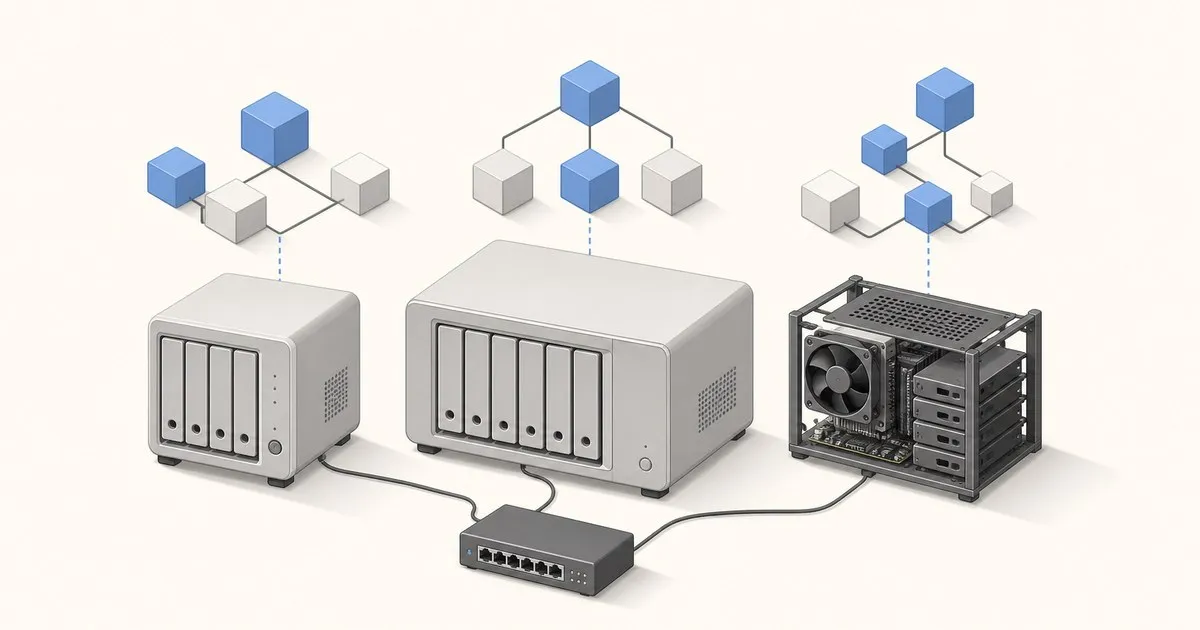
Best NAS for Docker Containers in 2026: Synology, QNAP, DIY
Five NAS models compared for running Docker at home, plus the third path most guides skip: which platforms actually work, which to buy, and what to avoid.
Finding the best NAS for running Docker containers is harder than it should be — the marketing copy all says “Docker support” but the experience ranges from polished and genuinely useful to borderline unusable, depending on the model and platform. This guide cuts through the noise: specific models, real trade-offs, and honest verdicts on when a NAS makes sense versus when a cheap mini PC is the better call.
Who This Is For (and Who Should Skip)
This guide is for homelab operators who want to consolidate Docker containers and network storage onto a single device. You’re running services like Vaultwarden, Nextcloud, Home Assistant, Jellyfin, or a reverse proxy, and you want them co-located with your data rather than on a separate box.
Skip the NAS route if you’re building a compute-heavy stack. NAS devices are power-efficient and reliable, but their CPUs are mid-range at best. If you’re running AI inference workloads, compiling code, or transcoding four simultaneous 4K streams, a mini PC with a proper Ryzen or Intel N-series chip runs rings around even a top-tier NAS. For reference on what container AI workloads actually consume, sentryml.com’s ML observability guides give a realistic picture before you commit to hardware.
Also skip if you need Kubernetes. K3s on a single QNAP works in a pinch, but it’s a stretch. For proper container orchestration, purpose-built hardware with more RAM headroom is worth the separate device.
What Matters for Docker on a NAS
CPU architecture is the hard gate. Docker on NAS means x86 only — specifically Intel or AMD. ARM-based NAS models (Synology DS124, DS223j, QNAP ARM budget lines) either don’t run Container Manager at all or run a hobbled version with no compose support. If Docker matters to you, filter out ARM before anything else.
RAM is the real constraint. Synology ships most models with 4 GB baseline. That’s enough for 3–5 lightweight containers, but a real self-hosted stack (database + reverse proxy + application + monitoring) easily consumes 6–10 GB. Budget for the RAM upgrade or confirm the model supports it before buying. To turn an intended stack into a number rather than a guess, the container resource calculator totals RAM and CPU per service, and the home server container roundup lists what each of those services actually costs in steady state.
AVX CPU support matters for some containers. MongoDB 5+, ERPNext, and a handful of other containers require AVX instruction set support. The AMD Ryzen R1600 in recent Synology Plus models has it. Older Intel Atom-based Synology hardware (J-series) doesn’t. If you’re planning to run any modern database or ML container, confirm AVX support.
Network interface. For Docker stacks that serve media or do frequent S3-sync to backup storage, a 2.5 GbE or 10 GbE port matters. Most modern Plus-tier models include 2.5 GbE. The Synology DS923+ offers an optional 10GbE expansion card.
Synology: The Polished Choice
Synology’s Container Manager (the successor to the legacy Docker package in DSM 7.2+) is the most approachable NAS container platform available. The UI is clean, Docker Compose support is built in, and the overview dashboard shows per-container CPU, RAM, and network stats without needing to touch a CLI. For someone coming from a standard Docker setup, the mental model maps cleanly.
DS923+ — Best overall Synology for Docker homelab. AMD Ryzen R1600 dual-core (3.1 GHz turbo), upgradeable to 32 GB DDR4 ECC, four bays, two M.2 NVMe slots for cache, and a 10GbE expansion option. This is the model to buy if you want serious headroom in a 4-bay chassis.
DS725+ — Best 2-bay option if you’re space or budget constrained. Same AMD Ryzen R1600 CPU as the DS923+, same RAM expandability ceiling, just two drive bays. Reasonable starting point for a focused stack (reverse proxy, password manager, home automation, one or two more services).
DS1522+ — 5-bay option at a higher price point, with the same AMD Ryzen CPU family. Justified if you need the extra bays for storage rather than additional Docker headroom — the CPU and RAM ceiling is comparable to the DS923+.
Hard pass: DS220j, DS223j, DS124, and anything else with the “j” suffix or an ARM processor. Container Manager won’t install, and even if you force it, the experience is unreliable.
One real limitation of Synology: it runs Docker in bridge networking mode by default, and getting containers onto your LAN via macvlan requires editing config files manually. It works, but it’s not wizard-driven. If a container on your NAS needs its own LAN address — a DNS filter or anything doing device discovery — the Docker macvlan setup guide covers the network definition and the host-reachability shim that Container Manager will not build for you.
QNAP: More Powerful, More Rough Edges
QNAP’s Container Station is genuinely more capable than Synology’s Container Manager. It supports Docker, LXD (full Linux container environments), Kata Containers (hypervisor-isolated), and K3s single-node Kubernetes. The real-time resource graphs per container are better, the networking tools are more flexible, and the CLI integration is deeper.
The trade-off: QTS is more complex to navigate than DSM, and QNAP had notable CVE-driven security incidents in recent years that Synology avoided. If you’re exposing any QNAP service to the internet, hardening and patching cadence need to be active habits, not afterthoughts. Security hygiene for self-hosted services is worth reading up on — the AI-aware threat tracking at ai-alert.org is a useful signal feed alongside standard CVE watches.
TS-464 — Best QNAP for Docker homelab. Intel Celeron N5095, which handles 4K HEVC hardware transcoding through its iGPU — useful if Plex or Jellyfin is part of your stack. Supports 16 GB RAM maximum. Four bays plus two M.2 slots.
TS-664 — Same N5095 platform, six bays. Choose this over the TS-464 if you need the extra drive slots. Same container support, same performance envelope.
TS-h886 — If you’re willing to spend significantly more, the h886 runs on the QuTS hero ZFS-based OS and offers much better storage resilience for data you actually care about. Better suited to a production-ish homelab than a casual one.
The Third Option: Dedicated Mini PC as a Docker Host, NAS Separately
Before locking in on a NAS with Docker, consider whether two separate devices solve the problem better: a NAS for storage (even a budget one, ARM is fine for SMB/NFS shares) and a dedicated mini PC for containers, mounting NAS shares as bind volumes.
This approach keeps the container host tuned for compute (more CPU, more RAM, cheaper per GB), and the NAS tuned for storage (drive bays, redundancy, ZFS scrubs). It’s also more flexible — you can upgrade either independently. The downside is two devices, two power draws, and two things to maintain.
If that split appeals, the compute half is covered in detail in the best mini PC for a Docker homelab breakdown — three price tiers, with the idle-power and networking trade-offs that decide which one belongs next to a NAS.
Storage and Backup
Whichever NAS you pick, Docker’s persistent data lives on named volumes or bind mounts to NAS shares. Don’t skip the backup step: container volumes are not protected by RAID. RAID protects against drive failure; it does not protect against accidental deletion, ransomware, or DSM/QTS software corruption.
A working backup strategy for a Docker NAS means periodic volume snapshots (DSM and QTS both support this) plus off-device replication — whether that’s Synology Hyper Backup to Backblaze B2, rclone to a remote bucket, or rsync to a second device.
Spec Comparison
| Model | CPU | Max RAM | Bays | 10GbE | Docker Platform |
|---|---|---|---|---|---|
| Synology DS923+ | AMD Ryzen R1600 | 32 GB | 4 | Optional (PCIe) | Container Manager |
| Synology DS725+ | AMD Ryzen R1600 | 32 GB | 2 | Optional (PCIe) | Container Manager |
| Synology DS1522+ | AMD Ryzen R1600 | 32 GB | 5 | Optional (PCIe) | Container Manager |
| QNAP TS-464 | Intel Celeron N5095 | 16 GB | 4 | No (2.5GbE) | Container Station |
| QNAP TS-664 | Intel Celeron N5095 | 16 GB | 6 | No (2.5GbE) | Container Station |
What to Actually Buy
For most homelab operators who want the best NAS for running Docker containers without a steep learning curve, the Synology DS923+ with a RAM upgrade to 16 GB is the answer. The DSM interface is polished, Container Manager covers the vast majority of self-hosted use cases with compose support, and the AMD Ryzen CPU has AVX for future-proofing your container choices.
If you want deeper container control, plan to run LXD alongside Docker, or want Kubernetes available as a local development target, the QNAP TS-464 is the better platform — just accept the steeper QTS learning curve and stay on top of firmware updates.
If you’re on a tight budget, consider a used Synology DS918+ or DS920+ — both run Container Manager and represent solid value on the used market, though RAM expandability tops out at 8 GB on the DS918+ (sufficient for modest stacks).
Related across the network
- NAS Slow Transfer Speeds: A Diagnosis Order — nashardwareguide.com
- Install Open WebUI With Docker: Setup Guide — openwebuihq.com
Sources
Related

Best Mini PC for a Docker Homelab in 2026: 3 Tiers Compared
Three mini PC tiers for a Docker homelab, from $150 N100 boxes to $900 networking-first barebones, with the RAM, storage, and ports each tier really needs.

Best Docker Containers for Your Home Server in 2026
A practical homelab operator's guide to the best docker containers for home server use: Jellyfin, Vaultwarden, Nextcloud, Tailscale and a dozen more.

Jellyfin Hardware Transcoding in Docker: QSV, NVENC, VA-API
Configure Jellyfin hardware transcoding in Docker Compose: copy-paste blocks for Intel QSV, NVIDIA NVENC and AMD VA-API, plus what to check when it fails.